
Fifty Shades of Green

10 November 2015
6 to 7 minutes
Green Vehicles come in all shapes, sizes and colors, and the push for their development is consistently growing and fueled by our desire to better the environment, high oil prices and government incentives. Every one of us knows about this trend, and some of us may even drive one ourselves. But what about the differences between the types of green vehicles, as well as the future expectations and market trends?
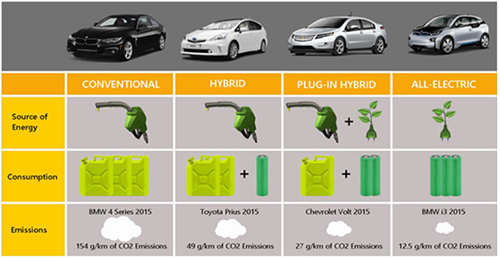
The main contributors of this movement are the so called “Big 3”: HEV’s (Hybrids), PHEV’s (Plug-in Hybrids) and BEV’s (Battery Electric). HEV’s make up the biggest portion of the green market, and the famous Toyota “Prius” was the pioneer for this trend. These vehicles utilize batteries at slow speeds, but diesel for speeds that the battery cannot handle, and thus emit less greenhouse gases as their conventional counterparts, with the 2015 “Prius” emitting 49 g/km of CO2.
The PHEV’s takes this trend a step further, particularly with the introduction of REEV’s (Range Extended Electric Vehicles), like the Chevrolet “Volt”, which extends the battery life. PHEV’s utilizes the battery as the main option, even at higher speeds. However, due to battery life being relatively short, the vehicle switches to diesel when necessary. Because the battery is the first-option, the emissions of CO2 for the newest “Volt” is at roughly 27g/km.
Finally, the BEV’s have been making a big splash in the playing field, with the famous BMW i3 being released in 2014. These vehicles run solely on electric batteries and therefore are ZEV’s (Zero Emission Vehicles) and emit no pollutants. However, opponents against this development have argued that the electricity used to fuel these vehicles still stems from coal/gas factories and therefore are not pure ZEV’s. When we calculate the average CO2 used to generate electricity for the BMW i3 it comes out to roughly 12.5 g/km, which is still significantly lower than any alternatives. But the average i3 emissions does not represent the majority of the electric market. In fact, when we take coal dominant markets like China or India as examples, we find that the emissions for electric vehicles can exceed 200 g/km when compared to green nations like Scandinavia where the emissions are close to zero. Thus the success of the BEV’s is highly dependent on the future energy sector.
Source: incadea 2015
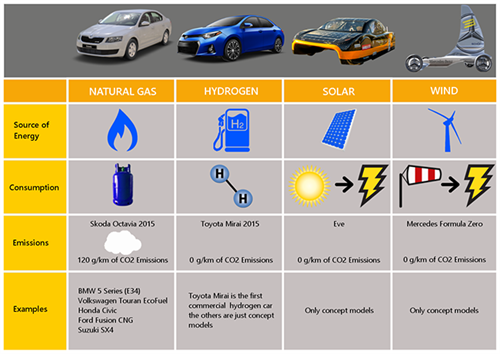
Alongside the development of the “Big 3”, other alternatives are being researched on a daily basis. Some of these are more feasible than others, but they are all showing promise. NGV’s (Natural Gas Vehicles) are the most prominent out of the alternative choices. In fact, there are currently roughly 15 million units in use, primarily in Asia and South America. The majority of these are CNG (Condensed Natural Gas), which uses gaseous compounds, while the less popular LNG (Liquefied Natural Gas) uses a liquid compound which is then converted to gas through combustion. The advantage to both of these methods is that the engine and other components do not corrode or rust as quickly as diesel, and many NGV’s have a mileage over 500,000km. The emissions are also cleaner, with average emissions reduced by 6-11%. A great example is the 2015 Skoda “Octavia” with CO2 emissions of 90-120 g/km.
Hydrogen vehicles are another example of innovations that have shown commercial potential. While most OEM’s are still conducting trial and error phases, Toyota has released the first hydrogen vehicle in December 2014. The “Mirai”, which can travel a distance of almost 700 kilometers and takes only five minutes to fuel with hydrogen, is the first step in a long process of producing this type of automobile for the masses. Similarly to the BEV’s, Hydrogen vehicles are technically ZEV’s, and release non-harmful water and heat as by-products. However, the production of hydrogen fuel once again is correlated with the actual emissions, and similar to BEV’s this number can fluctuate between 0 and over 200 g/km depending on country and efficiency of production. On top of this, since they are a new development, the price tag is often too high for everyday consumers.
Unfortunately, solar and wind energy vehicles have not had any commercial success, but the fact that they can run without plug-charging or combustion makes them intriguing for the future. For solar, there is a yearly competition known as the “World Solar Challenge,” where research teams present their innovations. One of the cars “Eve,” broke world records in 2014 when it traveled 500km on one charge at an average of 107km/h. Wind energy powered vehicles such as Mercedes “Formula Zero” have managed to reach peak speeds of 200km per hour, albeit it can only maintain these speeds for short periods of time.
Source: incadea 2015
So as we can see, the innovation of Green Vehicles has been relatively successful, and has become, in many cases, a cost-effective alternative when compared to the traditional vehicle. Northern European countries including Sweden, Norway and the Netherlands, are the biggest success stories, in which electric or hybrid vehicles are not only affordable but models like the Prius, and Tesla, or other makes are constantly leading in sales volume. This was made possible through government regulations and incentives, in which the purchasers of Green Vehicles not only receive tax breaks, but also free use of battery charging, highways, bus lanes and parking. In fact, these incentives have become so popular, that in the Netherlands, this policy is being changed to only incorporate battery electric vehicles by the end of 2015. This was done to push and promote fully electric vehicles but at the same time regain some tax income, because the policy got too popular.
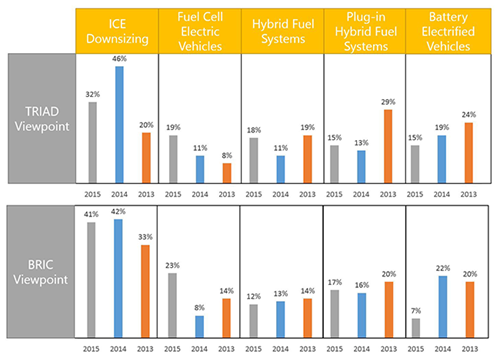
However, there is plenty of room for improvement within this sector of the industry. In fact, executives from the automobile industry aren’t as optimistic about green technologies in terms of investment. The blunt of the investment is still towards ICE downsizing, or simply reducing the size of the current engines to improve their efficiency and mileage (KPMG, 2014). Environmentally-friendly vehicles require high research and development costs, and the products are often too expensive for everyday consumers; or when affordably priced, offer only low profit margins. Due to this, most managers or directors at OEM’s simply prefer the most cost-effective and profitable strategy.
Source: KMPG Executive Survey 2015, Page 17-18, KMPG, 2015
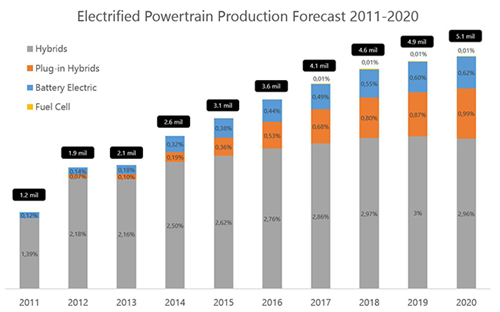
Another concerning fact is that Green Vehicles, although gaining popularity, still make up only a small percentage of both the vehicles on the road and production numbers. In fact, the dim forecasts have it that the production number sits at roughly 3% in 2014 and is only expected to rise to 4.6% in 2020 (KPMG, 2014). It is also concerning that this low percentage is dominated by hybrids, and that some of the very innovative solutions such as a BEV’s or Fuel Cell are barely scratching the surface. However, as the research and development costs fall, we can expect a faster rise in all segments, and the future continues to look brighter each day for the different shades of green.
10 November 2015
6 to 7 minutes

Related Insights articles

Automotive Joint-Venture Markets in China, How Long Can They Last?
In the 1980s, automotive OEM’s were salivating at the potential it offered.

What about Trucks? An Overlooked Industry
Trucks have remained relatively similar in terms of energy efficiency and appearance in the past 40 years, but